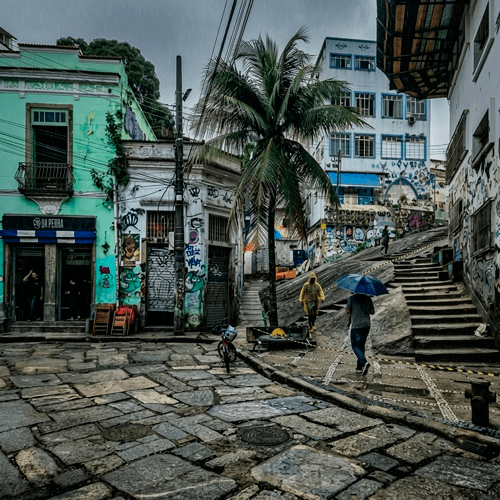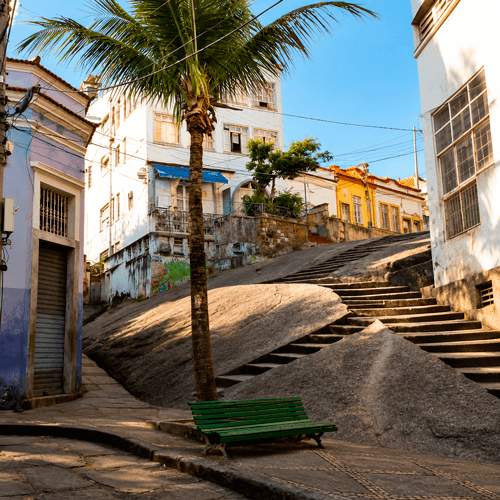
Pedra do Sal is a historic landmark, a residential area and an active cultural space in Rio de Janeiro. Located in Saúde, it is closely connected to Afro-Brazilian memory, religious traditions, Black community life and the development of urban samba.
This Pedra do Sal for foreigners guide explains how international visitors can plan the experience, use public transportation, confirm samba events, make payments and behave respectfully at a place that remains culturally important to local communities.
Pedra do Sal is not a conventional museum with controlled admission or fixed exhibition hours. Visiting the stone during the day is very different from attending a crowded evening event.
What Is Pedra do Sal?
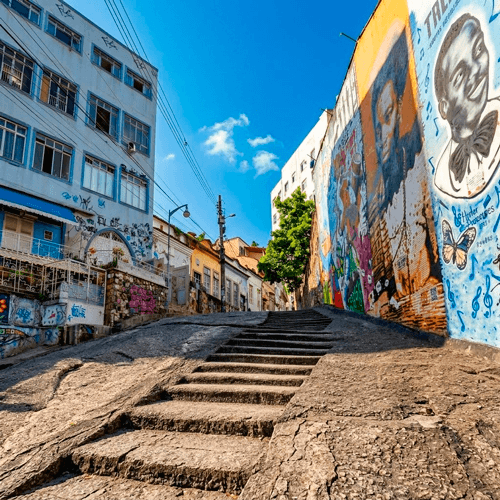
Pedra do Sal means “Salt Stone” in Portuguese. It is a historic rock formation surrounded by old houses, narrow streets, a stone slope and steps.
The name is associated with the unloading and movement of salt when the shoreline was much closer to this part of Rio de Janeiro. The stone was also cut during the nineteenth century to provide material for roads and port construction.
Over time, the area became a meeting place for Black residents, dockworkers, musicians, religious communities and migrants—particularly the women historically remembered as the tias baianas, or “Bahian aunties.”
Pedra do Sal received provisional state heritage protection on November 23, 1984, and definitive protection on May 11, 1987.
🌍 Why Is Pedra do Sal Important?
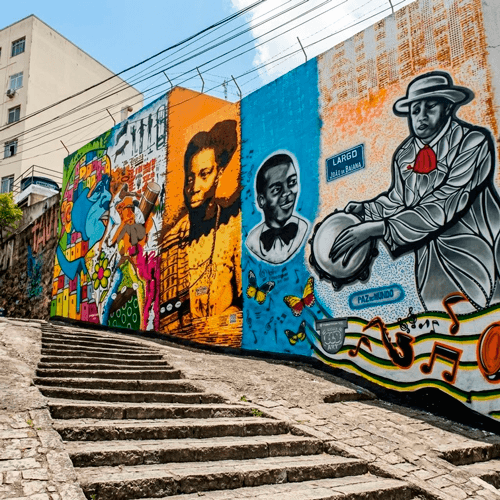
Pedra do Sal is part of the territory historically known as Pequena África, or “Little Africa.” This name refers to an area of central Rio de Janeiro shaped by African and Afro-Brazilian communities, cultural networks, religious practices and Black resistance.
Official heritage research describes Pedra do Sal as one of the oldest physical landmarks associated with the history of samba in Rio de Janeiro. It also identifies the site as a ritual space connected to Afro-Brazilian religions.
Its importance therefore goes far beyond entertainment. Pedra do Sal is connected to:
• Afro-Brazilian memory;
• the development of samba;
• Black urban history;
• Candomblé and other African-derived religious traditions;
• community life and cultural resistance;
• the history of the Quilombo da Pedra do Sal.
Visitors should approach it as a living cultural and residential place rather than simply a nightlife setting.
📍 Where Is Pedra do Sal Located?
Pedra do Sal is located on Rua Tia Ciata, in Saúde, in central Rio de Janeiro. Riotur also uses Largo de São Francisco da Prainha as a nearby reference point.
For map or ride-hailing searches, use:
Pedra do Sal – Rua Tia Ciata, Saúde, Rio de Janeiro
The immediate surroundings include narrow streets and pedestrian areas. During major events, crowds or temporary traffic restrictions may prevent vehicles from reaching the closest point.
Always check the map before leaving a taxi or ride-hailing vehicle.
ℹ️ Pedra do Sal for Foreigners: Practical Information
» Location: Rua Tia Ciata, Saúde, central Rio de Janeiro
» Type of place: Outdoor historic and cultural site
» Standard admission: No regular ticket for the public outdoor area
» Main experience: Afro-Brazilian heritage and samba when officially scheduled
» Daytime visit: Approximately 30 to 60 minutes
» Event visit: Approximately two to four hours
» Useful public transport: VLT Lines 1 and 3, followed by a walk
» Language: Portuguese; English service is not guaranteed
» Payments: Cash and cards vary by vendor; Pix may not be available to every foreigner
» Accessibility: Uneven stone, slopes and crowded streets can create barriers
» Children: A daytime visit is generally easier to organize
» Advance booking: Not required for an independent public visit
» Return planning: Essential when attending an evening event
🚇 How to Get to Pedra do Sal
Public transport can reduce the journey, but visitors should expect a final walk.
By VLT
The most useful VLT stops depend on the direction of travel and the route selected on the day.
Common options include:
→ Parada dos Navios–Valongo, on Line 1–Blue;
→ Santa Rita–Pretos Novos, on Line 3–Yellow;
→ Camerino–Rosas Negras, on Line 3–Yellow.
Parada dos Navios–Valongo is located on the Orla Conde, close to the Valongo area. Santa Rita–Pretos Novos and Camerino–Rosas Negras are located along Avenida Marechal Floriano. None of these stops is inside Pedra do Sal.
Walking time varies with the stop, chosen streets and individual pace. Check a live navigation app before leaving the VLT instead of relying on a fixed estimate.
The VLT currently operates every day from 05:00 to 23:00, or 5:00 a.m. to 11:00 p.m. The single fare is R$5.00.
Passengers must use:
→ a loaded Jaé physical card; or
→ a QR Code generated through the Jaé app.
The fare must be validated when boarding. Cash cannot be paid directly inside the train.
By Metro
Uruguaiana and Central do Brasil/Centro are practical metro stations for continuing toward Pedra do Sal, but neither station is immediately beside the site.
From either station, most first-time visitors will find it easier to continue by VLT, taxi or ride-hailing app instead of walking the entire route, especially at night.
The regular MetrôRio fare remains R$7.90. The system operates:
→ Monday to Saturday: 05:00 to 00:00;
→ Sundays and public holidays: 07:00 to 23:00.
MetrôRio also accepts contactless Visa, Mastercard and Elo cards, as well as compatible mobile devices. Authorization of a foreign-issued card still depends on the visitor’s bank and card settings.
By Train
Visitors using the SuperVia suburban railway should travel to Central do Brasil.
Central connects with MetrôRio and VLT Lines 2, 3 and 4. From there, continue by VLT, taxi or ride-hailing service.
Train schedules vary by branch, day and operational conditions. Check SuperVia’s official channels before relying on the train for a late return.
By Taxi or Ride-Hailing App
Use Pedra do Sal or Rua Tia Ciata as the destination.
Before leaving the vehicle:
→ compare the driver’s route with your saved map;
→ confirm that you are in Saúde;
→ choose a visible and active drop-off point;
→ avoid getting out on an unfamiliar or isolated street.
During busy events, the driver may need to stop a short distance away.
On Foot
Walking can be practical when coming from nearby central attractions during daylight hours.
Use familiar streets and an updated navigation app. Account for:
→ heat and strong sunlight;
→ sudden rain;
→ uneven sidewalks;
→ tram tracks;
→ busy road crossings;
→ reduced visibility after dark.
Visitors unfamiliar with central Rio may prefer a vehicle or the VLT for the return.
📅 What Is the Best Day to Visit Pedra do Sal?
The best day depends on what you want to experience.
For a quiet historical visit, choose a weekday morning or afternoon. During the day, it is easier to see the stone, stairs, houses and surrounding streets without a large event crowd.
For samba, Riotur currently publishes a recurring Monday roda de samba from 19:00 to 00:00, or 7:00 p.m. to midnight, with free admission.
However, Riotur’s other official pages are not completely consistent:
− one page mentions music from Thursday to Sunday;
− another describes programming from Friday to Monday starting at 18:00;
− the Pequena África guide highlights weekly samba on Monday and Friday.
Because the official information differs, the safest recommendation is:
Treat Monday from 19:00 to 00:00 as the clearest recurring official listing, but confirm the event on the same day. Do not assume that other weekly dates are guaranteed.
⏰ What Is the Best Time to Arrive?
For a historical visit, arrive between late morning and mid-afternoon. Daylight makes it easier to observe the stone and understand the surrounding streets.
For a confirmed samba event, arriving between 17:30 and 18:30 is a practical editorial recommendation. It provides time to:
» find the location before dark;
» understand the layout;
» buy water or food;
» identify the return route;
» avoid arriving during the busiest period.
These times are recommendations, not official opening hours.
Families, first-time visitors and travellers who dislike dense crowds may prefer an earlier arrival and a shorter stay.
🥁 How Do Samba Nights Work?
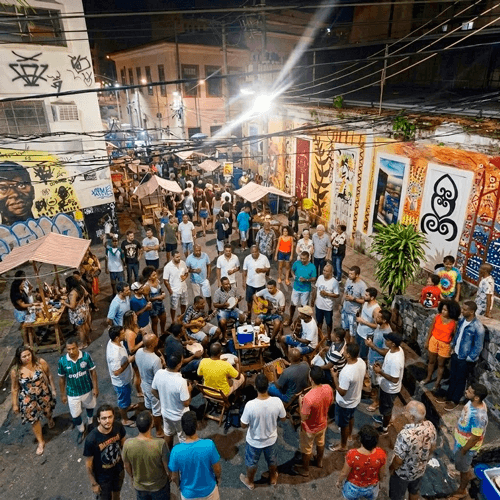
A roda de samba is a gathering where musicians perform samba together, traditionally arranged in a circle or compact group.
At Pedra do Sal, the event takes place in an outdoor urban setting. The public gathers around the musicians and along the nearby streets. Formal seating is limited, and much of the audience remains standing.
Crowd size, sound equipment, vendors and performance format can change according to:
♦ the organizer;
♦ the day;
♦ weather conditions;
♦ public holidays;
♦ special cultural events;
♦ city operations.
The Monday roda is currently advertised by Riotur as an outdoor event with free admission. Other activities connected to private businesses or independent producers may have different rules.
📱 How to Check the Current Samba Schedule
Check the schedule while planning and again on the day of the visit.
Riotur currently references:
→ @rodadesambadapedradosal for the traditional Monday roda;
→ @pedradosaloficial for broader local programming.
Before travelling, look for a current post containing:
→ the complete date;
→ starting time;
→ organizer’s name;
→ confirmation of the location;
→ admission information;
→ weather updates;
→ cancellation notices;
→ special access rules.
A post from a previous week is not confirmation that the next event will happen.
🎟️ Is Pedra do Sal Free?
There is no standard admission ticket for independently visiting the public outdoor area.
The traditional Monday samba is currently listed by Riotur as free.
Visitors may still pay for:
› guided tours;
› private productions;
› concerts inside nearby venues;
› food and drinks;
› reserved tables;
› transportation.
Do not assume that every event using the Pedra do Sal name takes place at the historic site or has free admission. Some paid productions use the name elsewhere in Rio de Janeiro.
👕 What Should Foreign Visitors Wear?
There is no formal dress code for visiting the public area.
Choose:
• lightweight clothing;
• comfortable closed shoes or trainers;
• clothing that allows easy movement;
• a light rain jacket when needed;
• discreet accessories.
Avoid high heels and unstable footwear because the stone, slopes and nearby sidewalks may be uneven.
There is no need to wear a samba costume or themed clothing. Dress naturally and prioritise comfort.
🎒 What Should You Bring?
Carry only essential items:
• a charged phone;
• portable battery;
• water;
• sunscreen;
• a card;
• a small amount of Brazilian currency;
• essential medication;
• light rain protection;
• your hotel address saved offline;
• an appropriate form of identification.
Avoid bringing:
• suitcases;
• large backpacks;
• expensive jewellery;
• unnecessary electronics;
• large amounts of cash.
Keep original travel documents in a secure place whenever another legally acceptable form of identification is appropriate for your activity.
💳 How Do Payments Work?
Credit cards, debit cards, contactless payments, cash and Pix are widely used in Brazil. Individual vendors around Pedra do Sal may accept different combinations.
Pix is Brazil’s instant payment system. Sending a Pix payment normally requires access through a participating financial institution or compatible payment provider. Many international visitors will therefore be unable to use Pix with their regular foreign bank account.
Ask before ordering:
– “Aceita cartão?” — Do you accept cards?
– “Quanto custa?” — How much does it cost?
Card terminals may have connectivity problems during crowded events. Carrying a small amount of cash can be useful, but avoid carrying more than necessary.
🗣️ Is English Spoken at Pedra do Sal?
Some guides, tourists, bar employees or event workers may speak English, but English-language assistance should not be expected everywhere.
No permanent official English-speaking visitor service at Pedra do Sal was identified during this update.
Save important information in Portuguese:
→ Pedra do Sal;
→ Rua Tia Ciata;
→ the name and address of your hotel;
→ the selected VLT or metro station;
→ your return pickup point.
An offline translation app can be helpful when mobile connectivity is unstable.
💬 Useful Portuguese Phrases for Visitors
⇒ Olá — Hello
⇒ Por favor — Please
⇒ Obrigado / Obrigada — Thank you
⇒ Quanto custa? — How much does it cost?
⇒ Aceita cartão? — Do you accept cards?
⇒ Onde fica a Pedra do Sal? — Where is Pedra do Sal?
⇒ Onde fica o VLT? — Where is the VLT?
⇒ Pode me ajudar? — Can you help me?
⇒ Quero chamar um carro — I want to call a car
⇒ A conta, por favor — The bill, please
⇒ Com licença — Excuse me
⇒ Não, obrigado / obrigada — No, thank you
🤝 Cultural Etiquette at Pedra do Sal
Pedra do Sal is part of a living neighbourhood and remains meaningful to Afro-Brazilian cultural and religious communities.
Visitors should:
♦ avoid blocking doors, stairs and residential entrances;
♦ keep passageways open;
♦ dispose of rubbish correctly;
♦ avoid excessive noise when leaving residential streets;
♦ ask permission before making close portraits;
♦ respect musicians and organizers;
♦ avoid intrusive filming;
♦ purchase from local vendors respectfully.
Do not touch candles, offerings or religious objects. Official heritage documents identify the stone as a ritual and symbolic place connected to Afro-Brazilian religious traditions.
📸 Can You Take Photos and Videos?
Personal photographs in the outdoor public area are generally possible, but consent and circulation remain important.
Ask before photographing a person closely. Avoid:
• flash near musicians or religious expressions;
• placing a tripod in a crowded passage;
• blocking stairs;
• filming residents through windows or doorways;
• treating ceremonies as entertainment content.
No single official rule covering every professional or commercial production was found. Professional filming may require authorization from municipal authorities, heritage bodies, property owners or event organizers.
🛡️ Is Pedra do Sal Safe for Foreign Tourists?
Safety conditions can vary with the time, event size, crowd and surrounding streets. Pedra do Sal should not be described as completely safe or automatically dangerous.
Practical precautions include:
− arrive before dark on your first visit;
− use established transportation routes;
− keep bags closed and in front of the body;
− use your phone discreetly;
− avoid displaying jewellery;
− carry limited cash;
− do not leave drinks or belongings unattended;
− moderate alcohol consumption;
− plan the return in advance;
− use a visible pickup point.
Solo travellers who are uncomfortable navigating central Rio independently may prefer a registered guide or organized group.
🚫 Common Mistakes Foreign Visitors Should Avoid
Avoid:
› assuming samba happens every night;
› travelling without checking the organizer;
› treating Pedra do Sal only as a party location;
› expecting everyone to speak English;
› carrying luggage;
› using unfamiliar shortcuts after dark;
› displaying expensive equipment;
› assuming every vendor accepts international cards;
› touching religious offerings;
› photographing people closely without permission;
› blocking residential entrances;
› depending on the final public transport departure.
Preparation is more useful than trying to improvise everything after arriving.
🍺 Food and Drinks Near Pedra do Sal
Bars, restaurants and temporary vendors may operate around Pedra do Sal during events. Riotur describes the area as having bars and food-and-drink stalls, with particularly strong movement on Mondays.
Availability and operating hours vary by business and date.
Before purchasing:
> confirm the price;
> ask which payments are accepted;
> check whether the bottle or can is sealed;
> include water in your plan;
> keep alcohol consumption moderate.
Nearby businesses are independent and should not automatically be presented as official event partners.
👨👩👧 Can You Visit Pedra do Sal With Children?
A daytime visit is generally easier for families.
During the day, families can see the historic stone and surrounding houses without the sound levels and crowd density of a major evening event.
Evening programming may become:
• loud;
• crowded;
• mostly standing;
• difficult for strollers;
• less convenient for bathroom access.
Not every event has the same age policy. Check the organizer’s information before bringing young children.
♿ Is Pedra do Sal Accessible?
Accessibility is limited by the physical structure of the historic site.
Potential barriers include:
◊ uneven stone surfaces;
◊ slopes;
◊ stairs;
◊ irregular sidewalks;
◊ narrow passages;
◊ large event crowds.
The VLT system itself provides level boarding, ramps, tactile flooring, Braille information and designated areas for wheelchair users. These resources do not guarantee an accessible route between the VLT stop and every part of Pedra do Sal.
A fully accessible official route through the historic stone was not confirmed.
Visitors with specific mobility requirements should consider a daytime visit, use a nearby vehicle drop-off and contact the event organizer before travelling.
🌧️ What Happens When It Rains?
Samba activities at Pedra do Sal are normally held outdoors, so rain can affect the event.
A single official rain policy covering every organizer does not exist.
Rain may result in:
− delays;
− cancellation;
− reduced attendance;
− slippery stone;
− increased ride-hailing demand;
− changes to the performance area.
Check the organizer’s same-day updates. A light waterproof jacket is often more practical than a large umbrella in a crowded street.
🌙 How Long Should You Stay?
Suggested times are:
» Historical daytime visit: 30 to 60 minutes;
» Early evening visit: one to two hours;
» Confirmed samba event: two to four hours;
» Visit with children: generally shorter;
» Public-transport-dependent visit: leave enough time to reach the stop or station before closing.
These are editorial estimates. The best duration depends on weather, crowding, personal comfort and the return plan.
🚋 How to Return to Your Hotel
Plan the return before reaching Pedra do Sal.
The VLT operates until 23:00, while MetrôRio normally operates until midnight from Monday to Saturday and until 23:00 on Sundays and public holidays.
Do not arrive at a station at the exact closing time. Leave enough time for:
→ the walk;
→ possible queues;
→ waiting for the next vehicle;
→ line connections;
→ temporary operational changes.
When using a ride-hailing app:
→ choose a visible pickup point;
→ verify the driver’s name;
→ check the vehicle model and licence plate;
→ confirm the hotel address;
→ do not enter a different vehicle;
→ expect higher demand after major events.
Visitors returning by SuperVia should verify the current schedule for their specific railway branch.
🧭 Should You Visit With a Guide?
Hiring a guide is not mandatory.
A qualified guide may be helpful for visitors who:
• do not speak Portuguese;
• are travelling alone;
• want historical context;
• want to understand Afro-Brazilian heritage;
• prefer organized transport;
• are uncomfortable navigating central Rio.
Before booking, confirm:
• language;
• meeting point;
• duration;
• total price;
• included services;
• cancellation policy;
• recent reviews;
• professional registration.
Registration with Cadastur is mandatory for people professionally working as tourism guides in Brazil, and the system can be consulted by travellers.
🏨 Practical Tips for Hotel Guests
Save the hotel’s complete address and telephone number in Portuguese.
Before leaving, ask reception staff to:
– confirm the route;
– help identify the correct transport direction;
– review the return plan;
– check the organizer’s latest post;
– recommend an appropriate pickup point.
Keep your phone charged and leave unnecessary valuables in a secure place. Solo travellers should consider sharing their expected return time with someone they trust.
✅ Quick Checklist Before You Go
– Confirm the event date and organizer.
– Check the weather.
– Save Rua Tia Ciata on your phone.
– Download an offline map.
– Plan the outward and return journeys.
– Save your hotel address in Portuguese.
– Charge your phone and battery.
– Carry limited cash.
– Wear comfortable shoes.
– Avoid unnecessary valuables.
– Learn a few Portuguese phrases.
– Respect residents and the cultural importance of the site.
❓ Frequently Asked Questions About Pedra do Sal
These quick answers cover the main practical questions international visitors may have before planning their visit.
Is Pedra do Sal worth visiting?
Yes. It provides meaningful contact with Afro-Brazilian heritage, samba history and a living cultural area of Rio de Janeiro.
Is Pedra do Sal free?
There is no standard ticket for independently visiting the public outdoor site. The recurring Monday samba is currently listed by Riotur as free.
Is Pedra do Sal safe at night?
Conditions vary. Use established routes, protect your belongings, avoid unnecessary valuables and plan the return. Personal safety cannot be guaranteed.
Does samba happen every day?
Do not assume so. Monday from 19:00 to 00:00 is the clearest recurring official listing, while additional dates vary and must be confirmed.
Can I visit Pedra do Sal during the day?
Yes. The daytime experience is generally quieter and better for observing the historic site.
Do I need to book in advance?
No booking is normally required for an independent outdoor visit. Guided tours and private events may require reservations.
Can I pay with an international credit card?
Possibly, but acceptance depends on the vendor, payment network and card issuer. Carry an alternative payment method.
Is there a dress code?
No formal dress code applies. Comfortable clothing and stable shoes are recommended.
Can I visit alone?
Yes, but first-time solo visitors should arrive early, use known routes and organize the return beforehand.
Is Pedra do Sal suitable for children?
A daytime visit is easier to organize. Evening events should be evaluated according to noise, crowding and organizer rules.
Can wheelchair users visit Pedra do Sal?
Some sections may be difficult because of the slope, stone surface, stairs and surrounding sidewalks. A completely accessible route was not confirmed.
Can I take professional photos?
Professional or commercial filming may require authorization. Contact the relevant authority and event organizer.
What should I do if it rains?
Check whether the event has been maintained, postponed or cancelled. Wear rain protection and prepare an alternative plan.
How late should I stay?
Base the decision on your comfort, transport schedule and expected crowd. Avoid depending on the final public transport service.
⭐ Is Pedra do Sal Worth Visiting for Foreigners?
Pedra do Sal offers international visitors an experience of Rio de Janeiro that goes beyond conventional sightseeing.
Its value comes from the connection between Black urban history, Afro-Brazilian religious memory, community life and samba. Understanding that context makes the visit more meaningful.
Preparation also matters. Confirm the event, choose the transport, carry only essential belongings and organize the return before arriving.
Most importantly, Pedra do Sal for foreigners should be approached as a place of heritage and living culture—not simply as an outdoor party.